
Mary Jane's War
NOTE
Joe B. Roles entered into the presence of the Lord on August 20, 2019.
https://www.grovesfuneralhome.com/obituary/joe-roles
May he rest in peace.
At the time of writing, (February 2026) there has been no further progress on the film. I will update here if I learn anything more.
Mary Jane’s war
A Monroe County Treasure
By Joe B. Roles
Treasures don’t always come with labels, there was a Monroe County treasure that looked like a creek rock and was kept in a cigar box for years until it was discovered to be the Jones Diamond.
There is another treasure just sitting along US Route 219 two miles southwest of Union, an iodine spring that is just as rare as any diamond and it is just waiting to be rediscovered. All it takes is publicity.
It is one of two known iodine springs in the world. As a boy growing up there I was always told that the other one was in Germany but it is in the Rimavska Sobota District of Slovakia near the Hungarian border. It is possible that in 1938 it was in Germany as the borders were constantly shifting between World War I and World War II or maybe Slovakia was just too hard to pronounce. That spring is known as Iodine Spa Resort Ciz which is very active with four hotels and attracts visitors from all over Europe, a real money maker.
This iodine spring in Monroe County is just one of three mineral springs located at Salt Sulphur Springs and part of a historical spa. The hotel itself will be 200 years on soon and reason enough to have a historical celebration. The first spring, the Sweet Sulphur Spring was discovered in 1802 when Erwin Benson, Esq. observed deer and buffalo licking for salt at that location so he bored for salt. A second Salt Sulphur Spring was discovered in 1805.
As word of the healing properties of these mineral waters spread it attracted visitors from other states primarily costal South Carolina. In 1820 the then owners Isaac Caruthers and William Erskine built a stone hotel, bath houses, a stone store and the quests built an Episcopal Church.
In 1838, while digging a drain for the other springs, an iodine spring was discovered. At that time a Dr. Thomas Dent Mutter was resident physician at the resort and under balneology himself had the water analysis by Professor William Barton Rogers at the University of Virginia and later by Dr. David Stuart of Baltimore. Dr. Mutter, who is mentioned in the book Mary Jane’s War, and later became Chairman of the Department of Surgery at Jefferson Medical College in Philadelphiawrote, as well as others, about the benefits of the water for both drinking and bathing as the principle still applies today “What goes on you goes in you.” From his writings of that time; “it is best in chronical conditions such as rheumatism, skin disorders, brain and nervous system as well as the intestinal track disorders. He also mentioned that it was contraindicated in acute or highly inflammatory affections.” It was always strange to me to find an iodine spring in a known goiter belt.
The decline of The Salt Sulphur Springs as a resort began in the post-Civil war economy. Then the decision to extend the railroad along the Greenbrier River instead of through Monroe County left the resort located on unpaved roads until 1930, then the Great Depression lead to its close in 1936.
With publicity that only a film can bring will attract investors and entrepreneurship, along with the growing popularity in natural apothecary could rebuilt The Salt into resort that would attract people from around the nation to build a flushing economy in Monroe County.
MARY JANE'S WAR
A Civil War Novel Based on a true Story Written by Joe B. Roles
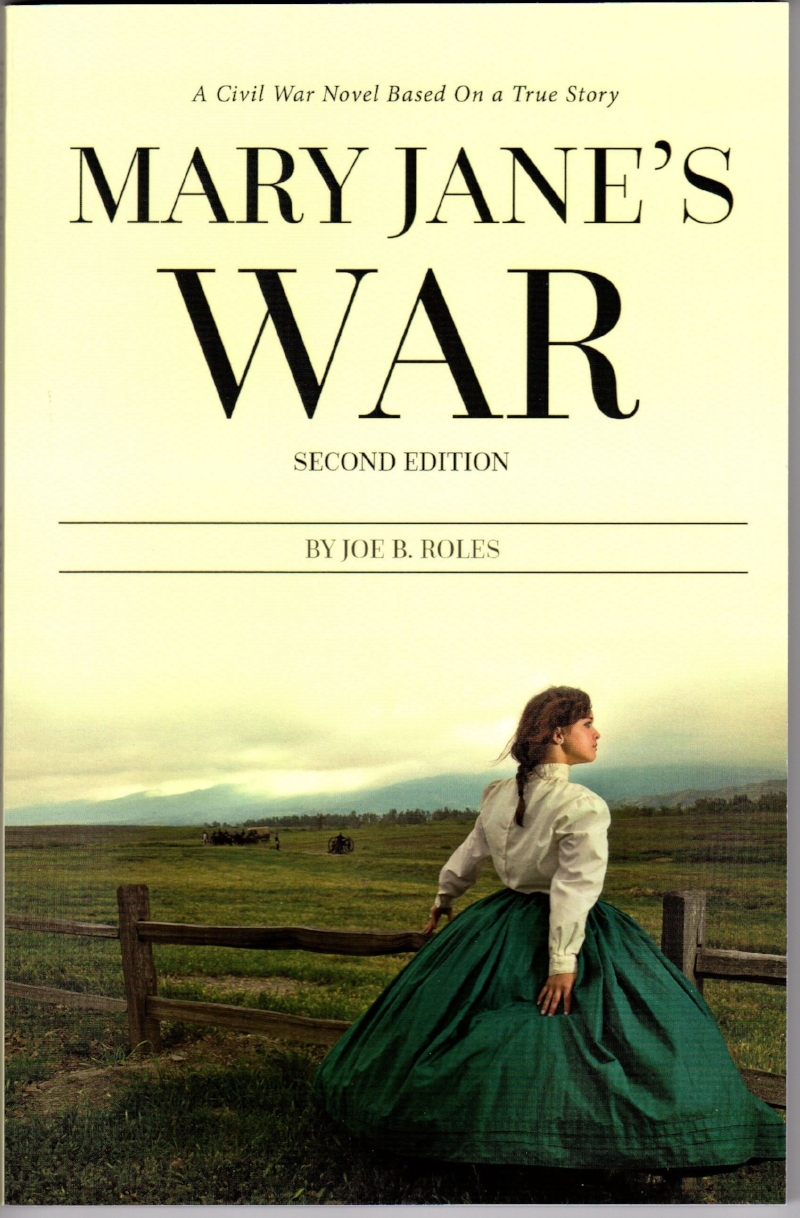
This book can be obtained from Amazon at this link. https://amzn.to/4r2HRlC
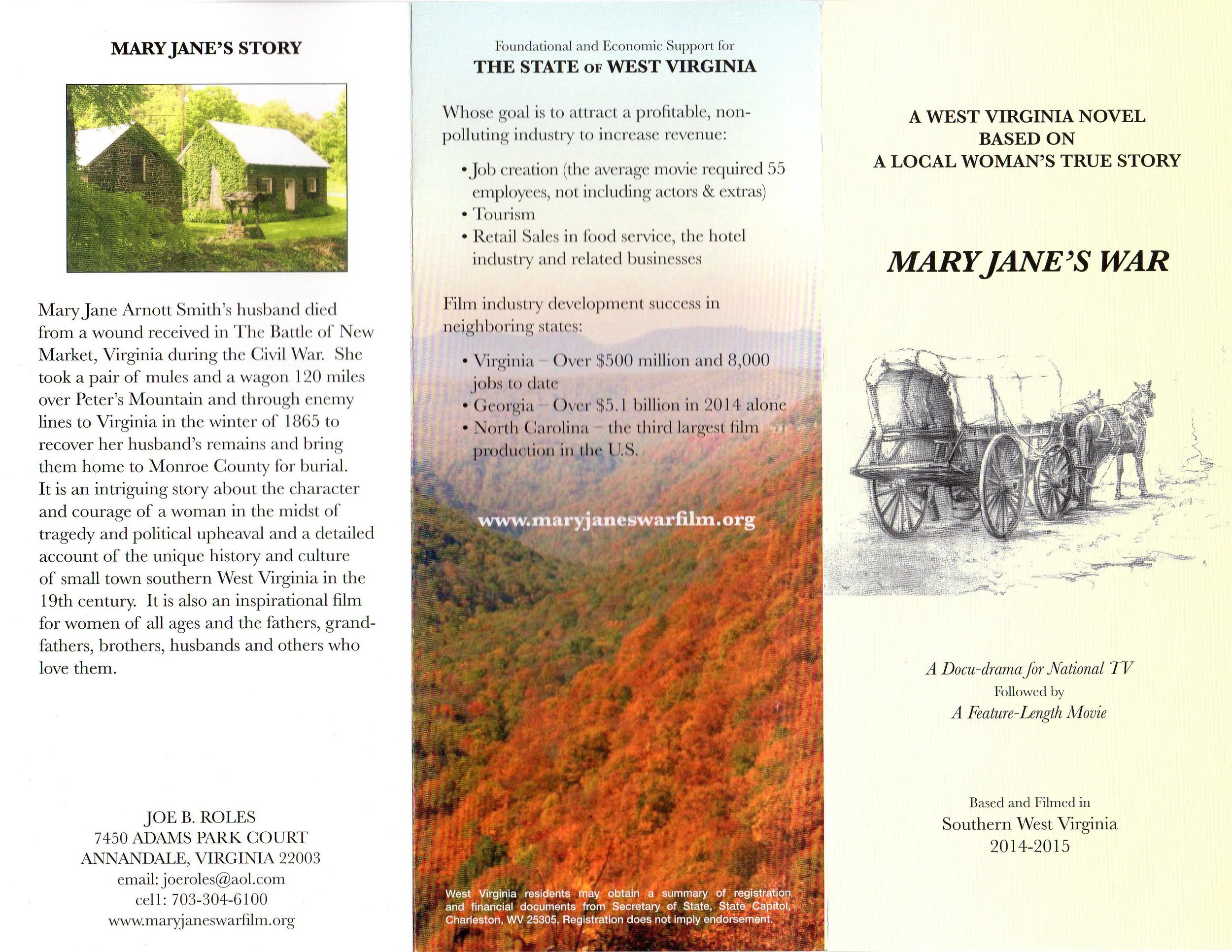
This is a true story of a woman's bravery and determination during the Civil War, an example of the character and culture that made America great.
Mary Jane Arnott Smith was the granddaughter of Revolutionary War soldier, Henry Arnot, Sr., who pioneered a frontier farm and raised a large family in Western Virginia. Life was not easy for her, as she had lost her mother at the age of six and as a young child was upset at the thought of rain falling on her mother's grave. She grew up helping her stepmother raise a large family on a hillside farm.
Her delight as a child was to walk the three miles to the Post Office and store at the then famous mountain resort of Salt Sulphur Springs, Virginia. The healing waters of the resort attracted the antebellum planters suffering from the heat, malaria and yellow fever of the low coastal plantations of South Carolina.
As time passed, Mary Jane married her childhood sweetheart Ralph Smith. They build a log home together and their family grew by six boys before a daughter came along. The Civil War came and Mary Jane witnessed the turmoil at the resort and the local military division as the excitement and glamour of the war grew into anger and hardship for all. At thirty-seven years of age with seven children and a farm to care for, Ralph Smith was reluctant to join the army even under local political pressure. Most of the people considered themselves to be part of Mother Virginia, and as Virginia went they would go, too.
Ralph did join the 30th. Virginia Sharp Shoots at Pearisburg, where he trained with a shortage of material and ammunition. He survived the winter by wearing his civilian clothes under his uniform. Meanwhile, back home he found his county was now part of the new state of West Virginia --a Union state --and he was suddenly at war with his own county. After months of drilling, Ralph's unit was ordered to join General John C. Breckinridge's army to march down the valley to meet General Franz Sigel's Union Army as it advanced up the valley. In the Battle of New Market on May 15, 1864, Ralph was shot in his right leg. He was carried by farm wagon to the hospital in Harrisonburg, Virginia where he later died from gangrene. His remains were sent to the burned out gymnasium at Virginia Military Institute with a notice sent to next of kin.
Mary Jane didn't receive the letter until September 27th. . The following Sunday she stood up in church and announced to everyone's astonishment that she was going to Lexington to pick up his remains and bring them home for burial.
After the fall crops had been harvested and preparations made for the trip, including wagon and mules, it was determined that they would leave on January 2. It was also the wisdom of both Mary Jane's and Ralph's parents that she take a freed slave that had been in Ralph's family for years to go as driver since Mary Jane had lost three fingers in a farm accident. In addition, they thought she should take her three oldest boys as scouts, reducing the chance of being robbed. And so, the group was formed and prepared for the journey.
The 120-mile journey to Lexington, VA was a difficult one. It took them through Sweet Spring, and Clifton Forge, and then a detour through Buchannan due to heavy snow on North Mountain. They found themselves threatened by Union Solders near Buchannan and barely escaping a night attack due to the bravery of her boys. On the return they encountered bitter weather and a snow storm. They survived by finding a vacant church on the mountain. And after eighteen days on the road with a nearly exhausted food supply, they were saved again by a kind farmer and his wife who came to their aid before arriving home to receive a hero's welcome. Ralph was laid to rest in their community cemetery as a wounded soldier played “How Great Thou Art" on a bugle.
(Edited by Robert Arnott from story notes by author Joe B. Roles)
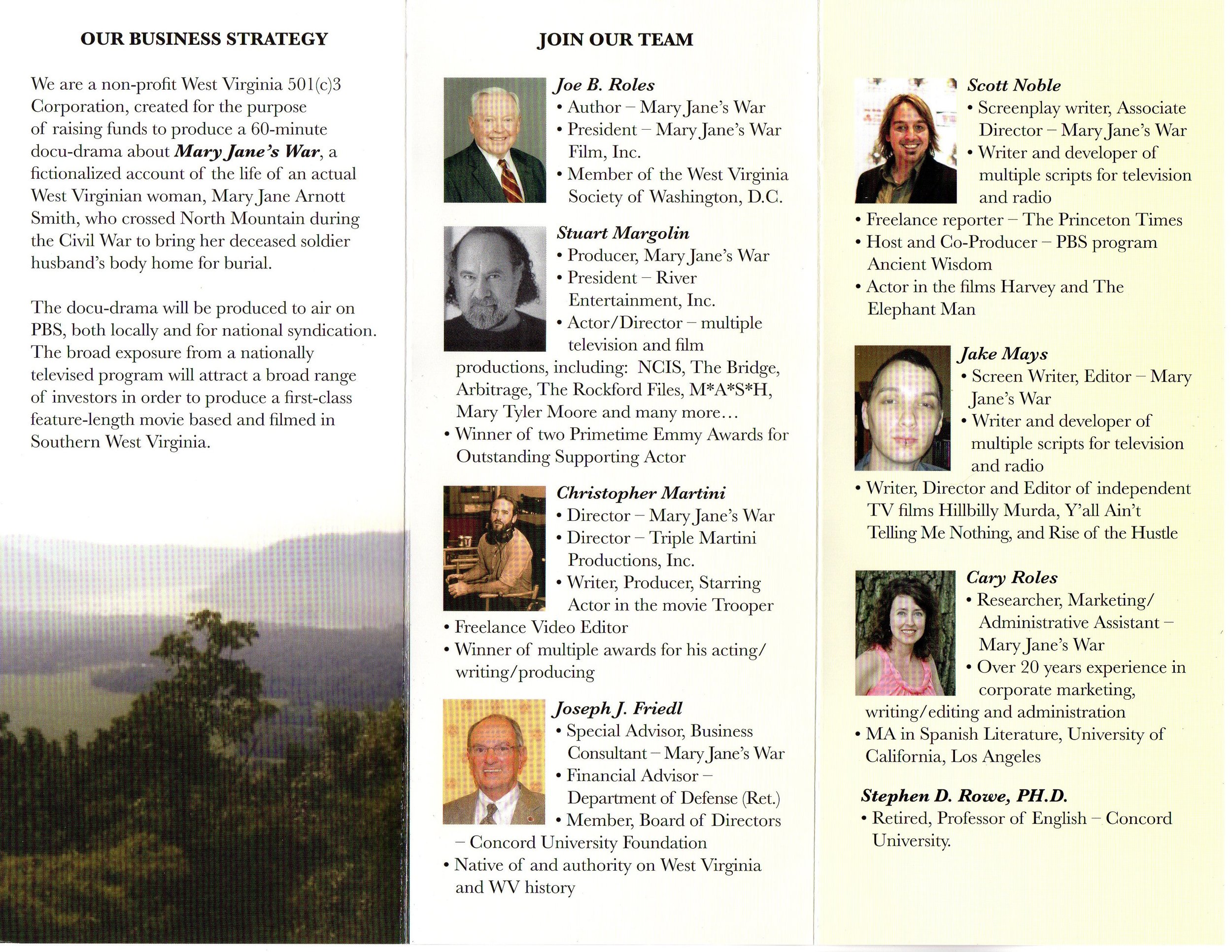
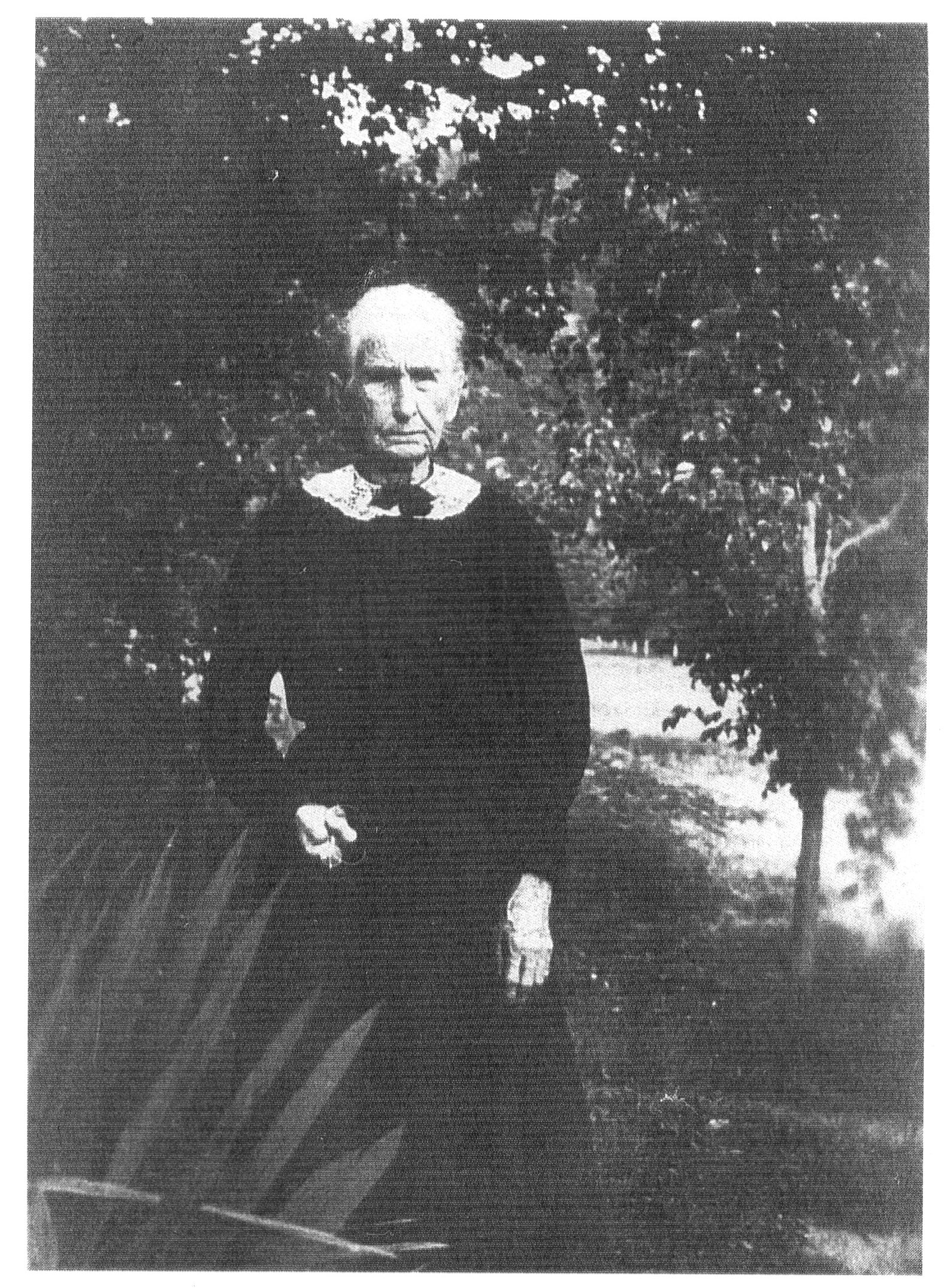
Courtesy of Joe B. Roles. This surviving image of Mary Jane Arnot Smith ca. 1912 was provided to Joe by the Smith Family. Mary Jane raised her seven children by herself and operated the farm until her death in 1914 at the age of 90. Whenever she had a photograph made she would try to cover the hand with the missing fingers with a hankerchief (from Mary Jane's War, pg. 151).